News & Updates
National Framework Sets Out One Coordinated Architecture for Humanitarian Response and Poverty Reduction
The OHOPRS National Framework establishes an integrated architecture for coordinating humanitarian action, social protection and poverty reduction through connected governance, data, service delivery, financing and accountability systems.
National Framework Sets Out One Coordinated Architecture for Humanitarian Response and Poverty Reduction
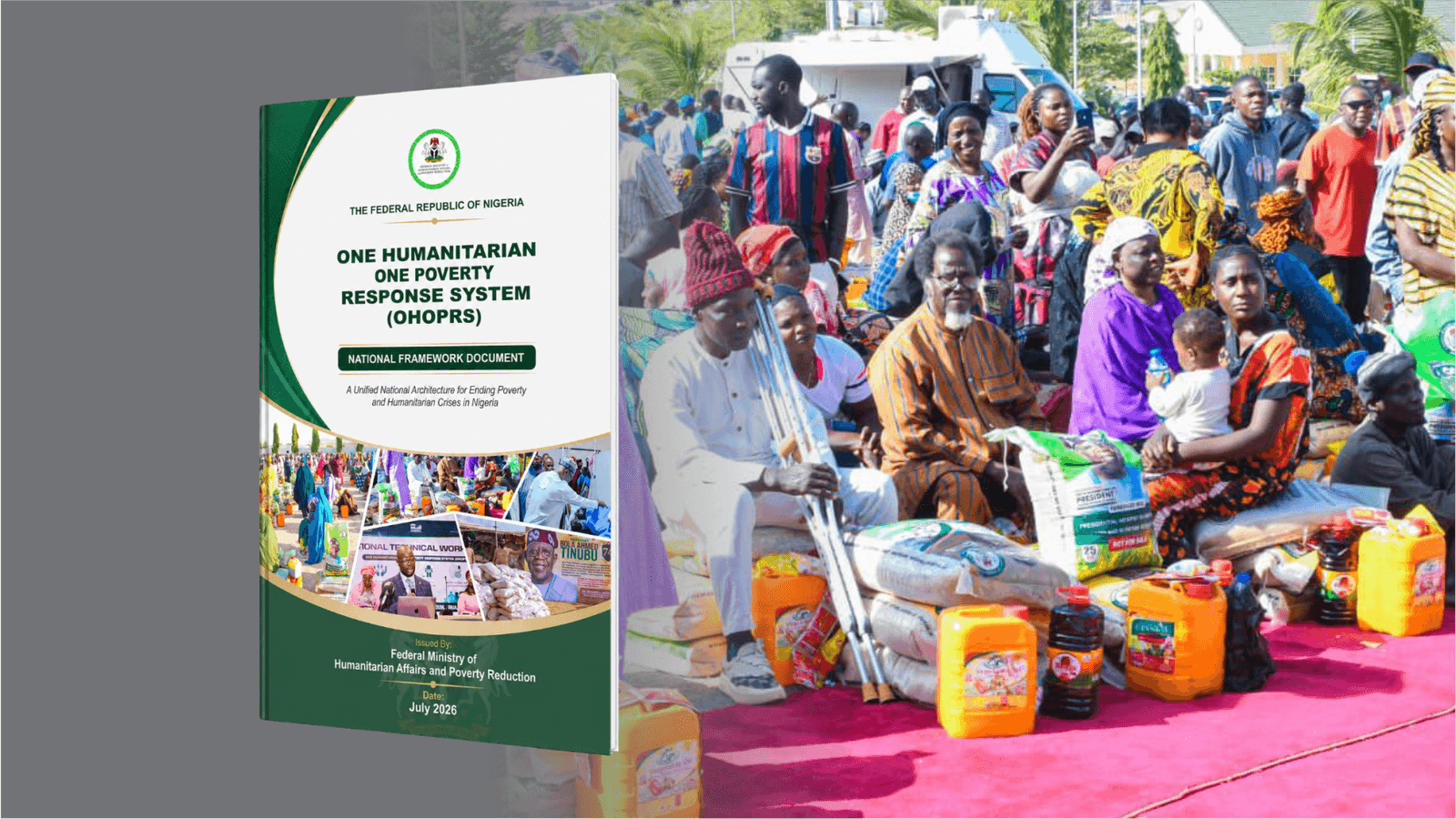
The One Humanitarian One Poverty Response System (OHOPRS) National Framework sets out a unified national architecture for strengthening the way Nigeria coordinates humanitarian response, social protection and poverty-reduction interventions.
Rather than creating another stand-alone programme, OHOPRS provides a common framework through which institutions, interventions, data, resources and delivery structures can work more coherently around the needs of vulnerable people and communities.
Building one national system
Nigeria's humanitarian and poverty-response landscape involves multiple government institutions, development partners, programmes and delivery structures.
Each has an important role. The challenge is ensuring that these different efforts do not operate as disconnected interventions.
OHOPRS addresses this challenge by providing an overarching architecture that connects five fundamental dimensions of the response system:
Governance – coordinated institutions, clearly defined responsibilities and accountability.
Data and Intelligence – integrated information, registries, targeting, monitoring and evidence to support better decisions.
Service Delivery – connecting interventions so that support responds to assessed needs and contributes to longer-term progress.
Financing – improving coordination, transparency and accountability around resources.
Accountability and Learning – monitoring performance and outcomes, incorporating feedback and using evidence to continuously improve delivery.
Together, these elements provide the institutional foundation for a more connected national response.
Government-led and nationally owned
A central principle of the National Framework is government leadership and national ownership.
The system is intended to strengthen coordination across institutions and levels of government while providing a common architecture within which humanitarian, social-protection and poverty-reduction interventions can operate.
At the Federal level, national policy, standards and overall system coordination provide direction.
At the State level, the architecture supports alignment, oversight and integrated implementation.
At the Local Government level, national policy connects with frontline delivery and the realities of households and communities.
This Federal-State-Local connection is important because poverty and humanitarian vulnerability are ultimately experienced locally.
Connecting information to action
Effective humanitarian and poverty reduction responses depend on knowing who requires support, understanding the nature of vulnerability and being able to follow what happens after an intervention is delivered.
For this reason, data and intelligence form an important part of the OHOPRS architecture.
Identification, vulnerability assessment, registries, monitoring and evidence are intended to contribute to a shared understanding of need and progress.
The objective is not simply to collect more information. It is to ensure that information supports better targeting, delivery, accountability and decision-making.
Connecting humanitarian response and development
The National Framework also recognises that humanitarian crises and long-term poverty cannot always be addressed independently.
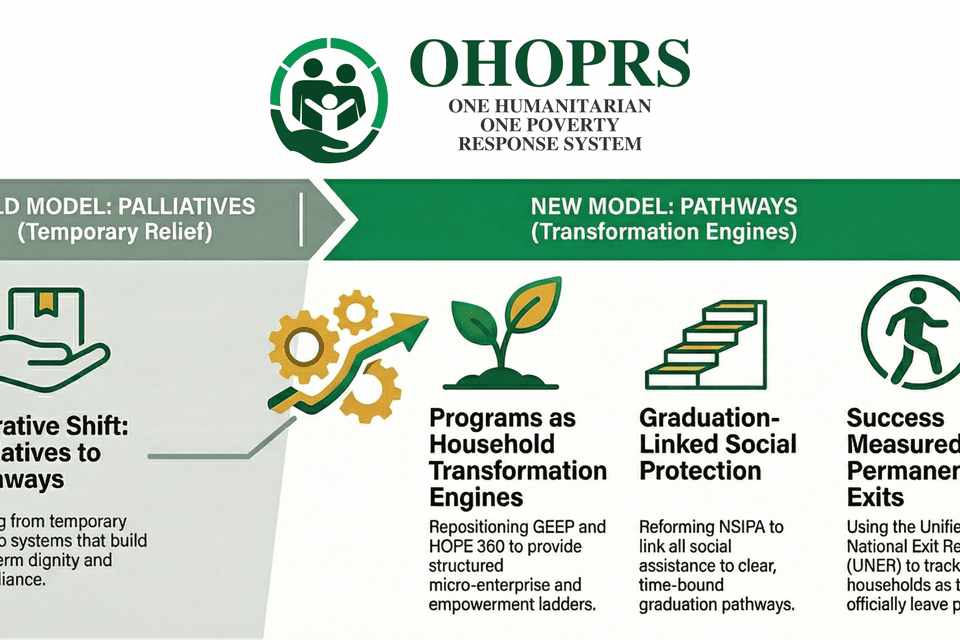
Immediate humanitarian assistance may protect life and dignity during a crisis, but households and communities can also require recovery support, social protection, livelihood opportunities and stronger resilience against future shocks.
OHOPRS therefore incorporates the Humanitarian-Development-Peace Nexus, helping connect urgent response with recovery, development and resilience while recognising the distinct role of each.
This creates the basis for support that can respond to immediate needs without losing sight of longer-term progress.
From activities to measurable outcomes
Another important element of the Framework is accountability for results.
Success cannot be understood only by recording activities or expenditure. A stronger response system must also examine what those activities produce and what ultimately changes for people and communities.
The OHOPRS results logic therefore connects:
Activity → Output → Outcome → Impact
This provides a foundation for progressively linking interventions and resources to measurable results, institutional learning and improved decision-making.
A foundation for coordinated action
The National Framework provides the institutional foundation upon which the wider OHOPRS architecture can operate.
Its purpose is to make coordination more systematic, data more useful, delivery more connected and accountability more closely linked to outcomes.
Ultimately, the ambition is straightforward: to ensure that Nigeria's humanitarian and poverty-reduction efforts increasingly function as one coordinated national response, capable of connecting immediate assistance with sustainable pathways towards resilience, dignity and poverty exit.