News & Updates
OHOPRS: From Palliatives to Pathways
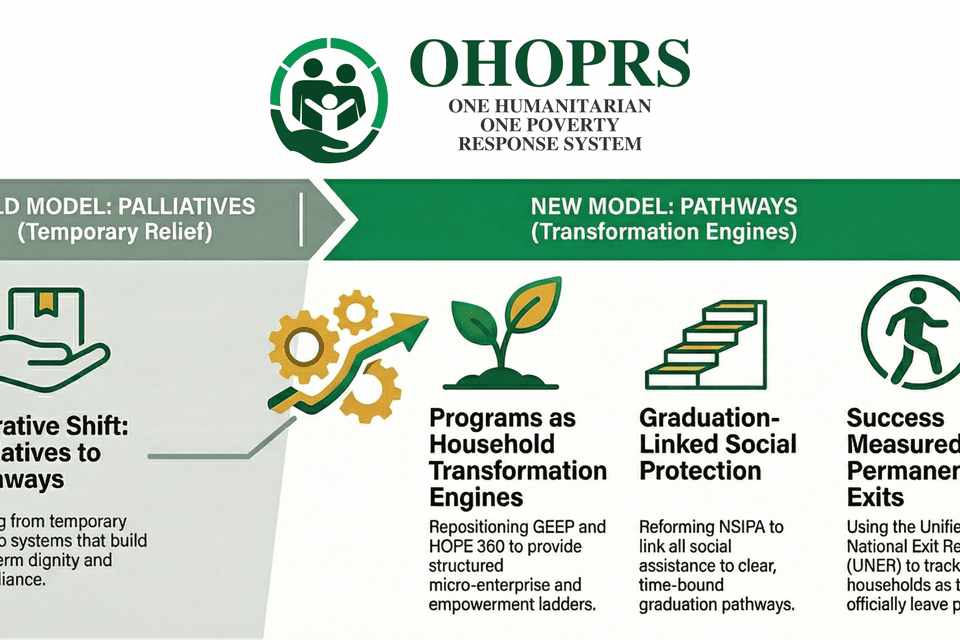
OHOPRS is reframing humanitarian and poverty reduction efforts from repeated short-term relief toward coordinated pathways that connect vulnerable households to resilience, livelihoods, dignity and self-reliance.
OHOPRS: From Palliatives to Pathways
Nigeria's humanitarian and poverty-reduction response is entering a new phase, one that seeks to move beyond repeated short-term interventions towards systems capable of creating sustainable pathways out of vulnerability and poverty.
At the heart of this shift is the One Humanitarian One Poverty Response System (OHOPRS), an integrated national architecture designed to connect humanitarian response, social protection and poverty reduction through coordinated governance, data, delivery and accountability.
The direction is captured in a simple but important idea: From Palliatives to Pathways.
Moving beyond temporary relief
Humanitarian assistance remains essential. When people face displacement, conflict, disaster, food insecurity or severe economic shocks, immediate support can protect lives and help households withstand crisis.
But emergency assistance alone cannot provide a permanent answer to poverty.
OHOPRS therefore seeks to connect immediate support to a wider pathway that can help vulnerable households move towards recovery, resilience, livelihoods, economic inclusion and greater self-reliance.
The shift is not about abandoning relief. It is about ensuring that, wherever possible, relief leads somewhere.
From fragmented interventions to one response
Nigeria's humanitarian and poverty-response landscape includes multiple institutions, programmes, delivery structures and data systems.
When these operate independently, coordination becomes more difficult. Interventions can become fragmented, information can remain disconnected and measuring a household's progress beyond the immediate assistance received becomes harder.
OHOPRS provides a framework for bringing these elements into a more coherent national architecture.
The goal is to move:
From Temporary Relief to Systemic Access and Dignity
From Palliatives to Pathways
From Projects to Systems
From Spending to Results
From Dependency to Dignity and Self-Reliance
These shifts represent a change not only in programmes, but also in how success is understood.
Putting people on a pathway
Under the OHOPRS approach, support should not be viewed simply as an isolated transaction.
A household experiencing vulnerability may require immediate humanitarian assistance. As circumstances stabilise, other forms of social protection, livelihood recovery and economic inclusion may become appropriate.
The pathway can therefore connect:
Humanitarian Support → Social Protection → Livelihood Recovery → Economic Inclusion → Resilience → Self-Reliance
This is not intended to be a rigid sequence. Different households face different circumstances, and people may enter, move through or return to different forms of support according to their needs and context.
What matters is that interventions are connected to a wider understanding of progress.
Building systems around outcomes
The Strategic Blueprint places particular emphasis on changing the way poverty-reduction efforts are understood and measured.
It calls for a transition from projects towards systems and from spending towards results.
That means asking more than how much assistance was distributed or how many activities were carried out. It means increasingly asking whether interventions are reducing vulnerability, strengthening resilience and helping households progress towards sustainable livelihoods and greater independence.
OHOPRS therefore connects delivery with monitoring, evidence, accountability and learning.
The objective is a system in which what happens on the ground can inform future planning, targeting and decision-making.
Local delivery, national coordination
Poverty is ultimately experienced in households and communities.
For this reason, OHOPRS connects national coordination with State and Local Government delivery.
At the Federal level, the architecture provides national policy direction, standards and coordination. States support alignment, oversight and integrated implementation, while Local Governments serve as critical frontline delivery platforms closest to communities and households.
The intention is to create a system in which national direction and local realities continually inform one another.
Dignity at the centre
The transition from palliatives to pathways ultimately concerns people.
It is about ensuring that humanitarian and poverty-reduction interventions do more than respond to today's hardship. They should, wherever possible, help create the conditions for tomorrow's stability, opportunity and dignity.
This philosophy is captured in the Strategic Blueprint's defining statement:
“Relief keeps people alive. Poverty reduction gives people a future. This Ministry exists to build the systems that make that future permanent.”
Through OHOPRS, the ambition is to build the institutional connections required to turn that principle into a coordinated national approach: one humanitarian response, one poverty response system, and a clearer pathway from vulnerability towards resilience and self-reliance.